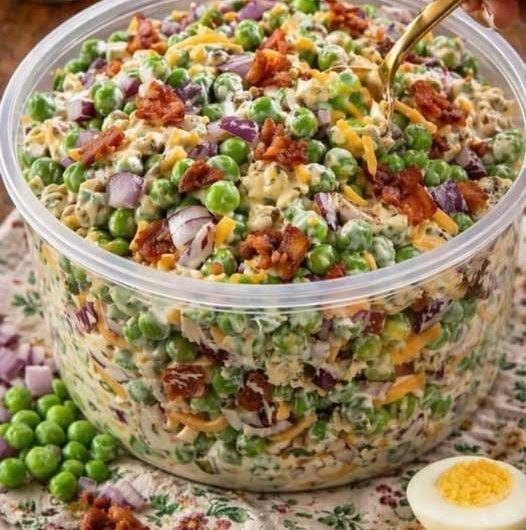
Bacon–pea salad is a cold, creamy salad that combines sweet green peas, crispy bacon, and a rich mayonnaise-based dressing. It is commonly served at picnics, barbecues, potlucks, and family gatherings because it is easy to prepare in large quantities, travels well, and pairs with many main dishes.
At its core, this dish is about contrast:
- Sweetness from peas
- Saltiness and smokiness from bacon
- Creaminess from dressing
- Sharpness from onion
- Optional crunch from celery or nuts
Even though the ingredients are simple, the final quality depends heavily on technique: how the bacon is cooked, how the peas are handled, and how the dressing is balanced.
2. WHY THIS SALAD IS POPULAR
This salad is widely loved because it hits multiple sensory notes at once:
Flavor balance
- Bacon adds deep savory umami
- Peas add natural sweetness
- Dressing adds tang and richness
Texture balance
- Soft peas
- Crisp bacon
- Creamy coating
- Optional crunch from vegetables or seeds
Practical benefits
- Can be made ahead of time
- Serves many people cheaply
- Requires no complex cooking skills
- Works as side dish or light meal
3. INGREDIENTS (EXTREMELY DETAILED)
3.1 Green Peas (Main Ingredient)
You will need:
- 4 cups green peas (fresh or frozen)
Best choice:
Frozen peas are most commonly used because:
- They are picked at peak ripeness
- They retain sweetness and color
- They are easy to store year-round
Fresh peas:
- Slightly sweeter and firmer
- Require shelling and brief cooking
- More labor-intensive
Important handling:
Peas must NOT be watery when mixed. Excess moisture ruins texture and makes dressing runny.
Steps:
- If frozen: thaw fully in cold water
- Drain completely
- Pat dry with towel
- Let sit for a few minutes to release surface moisture
3.2 Bacon (Flavor Backbone)
You will need:
- 8 to 10 slices bacon
Role of bacon:
- Provides saltiness
- Adds smoky depth
- Gives crunch and chew contrast
Types of bacon:
- Regular bacon: balanced fat and meat
- Thick-cut bacon: more chew and texture
- Smoked bacon: stronger flavor impact
3.3 Red Onion (Sharpness and Aroma)
You will need:
- 1 small red onion, finely diced
Purpose:
- Cuts through creaminess
- Adds slight pungency
- Improves complexity
Important:
Onion must be finely chopped to avoid overpowering bites.
Optional technique:
Soak chopped onion in cold water for 10 minutes to reduce sharpness.
3.4 Cheese (Creamy richness)
You will need:
- 1 cup cheddar cheese
Options:
- Mild cheddar: smooth and creamy
- Medium cheddar: balanced flavor
- Sharp cheddar: stronger bite
Forms:
- Cubed: adds texture
- Shredded: blends into dressing
3.5 Celery (Optional Crunch Element)
You will need:
- 1/2 cup finely chopped celery
Purpose:
- Adds freshness
- Adds crunch
- Lightens heavy creaminess
4. DRESSING (HEART OF THE SALAD)
Ingredients:
- 3/4 cup mayonnaise
- 2 tablespoons sour cream
- 1 tablespoon apple cider vinegar or lemon juice
- 1 teaspoon sugar (optional)
- Salt to taste
- Black pepper to taste
4.1 Understanding the dressing chemistry
This dressing is a balance of:
- Fat (mayonnaise)
- Acid (vinegar or lemon juice)
- Creaminess (sour cream)
- Seasoning (salt and pepper)
- Slight sweetness (optional sugar)
Each component affects the final result.
4.2 Why each ingredient matters
Mayonnaise
Provides:
- Base structure
- Creaminess
- Fat content that carries flavor
Sour cream
Provides:
- Tanginess
- Lighter texture than mayo alone
Acid (vinegar/lemon)
Provides:
- Brightness
- Cuts through fat
- Prevents heaviness
Sugar (optional)
Balances:
- Acid
- Salt
- Bitter notes from onion
4.3 Dressing preparation method
- Add mayonnaise to bowl
- Add sour cream
- Add vinegar or lemon juice
- Add salt and pepper
- Whisk until completely smooth
Then taste carefully:
- Too thick → add small splash of milk
- Too tangy → add a bit more mayo
- Too bland → adjust salt
5. BACON COOKING TECHNIQUE (IMPORTANT SECTION)
Step-by-step method:
- Place bacon in cold pan
- Turn heat to medium
- Let fat slowly render
- Turn occasionally for even crisping
- Cook until golden and crisp
Why this method matters:
Starting bacon in a cold pan:
- Prevents burning edges
- Allows even fat rendering
- Produces better texture
After cooking:
- Remove bacon onto paper towels
- Let it cool completely
- Chop or crumble into small pieces
Common mistake:
Adding bacon while hot into salad can:
- Melt dressing
- Soften texture
- Make salad greasy
6. PEAS PREPARATION (CRITICAL FOR TEXTURE)
Frozen peas method:
- Place peas in bowl
- Cover with cool water
- Let thaw 10–15 minutes
- Drain thoroughly
- Dry with towel
Fresh peas method:
- Boil lightly for 2–3 minutes
- Immediately transfer to ice bath
- Drain fully
- Dry completely
Why drying matters:
Water causes:
- Runny dressing
- Diluted flavor
- Poor texture
7. ASSEMBLY PROCESS (DETAILED)
Step 1: Combine dry ingredients
In a large bowl add:
- Peas
- Bacon
- Onion
- Cheese
- Celery
Mix lightly.
Step 2: Add dressing
Pour dressing over mixture.
Step 3: Mixing technique
Use gentle folding motion:
- Do not stir aggressively
- Do not mash peas
- Ensure even coating
Step 4: Final adjustment
Check:
- Creaminess level
- Salt level
- Overall balance
Adjust if needed.
8. CHILLING (VERY IMPORTANT STEP)
Minimum time:
1 hour
Best time:
2–6 hours
Ideal:
Overnight refrigeration
Why chilling matters:
During chilling:
- Bacon flavor spreads
- Dressing thickens
- Peas absorb seasoning
- Onion mellows
9. SERVING GUIDE
Serve cold directly from fridge.
Best pairings:
- Grilled chicken
- Steak
- Burgers
- Sandwiches
- BBQ ribs
Serving tip:
Stir gently before serving to redistribute dressing.
10. STORAGE
- Refrigerate in airtight container
- Lasts 2–3 days maximum
- Best eaten within 24 hours for peak texture
11. COMMON PROBLEMS AND FIXES
Problem: Watery salad
Cause:
- Wet peas or vegetables
Fix:
- Always dry ingredients thoroughly
Problem: Too heavy
Fix:
- Add more vinegar or lemon juice
- Add celery or onion
Problem: Bland taste
Fix:
- Increase salt
- Add black pepper
- Add small splash of vinegar
Problem: Bacon soggy
Fix:
- Add bacon just before serving
Problem: Dressing too thick
Fix:
- Add small amount of milk or yogurt
12. VARIATIONS (EXTENSIVE)
12.1 Healthier version
- Replace half mayo with Greek yogurt
- Add extra celery
- Reduce bacon slightly
12.2 Protein-rich version
- Add chopped boiled eggs
- Add grilled chicken pieces
12.3 Crunchy version
- Add sunflower seeds
- Add almonds or walnuts
- Add diced cucumber
12.4 Sweet twist version
- Add dried cranberries
- Add honey in dressing
- Add sweet corn
12.5 Gourmet version
- Add feta cheese
- Add Dijon mustard in dressing
- Use smoked bacon
13. FLAVOR SCIENCE (WHY IT WORKS)
This salad works because of balance principles:
- Fat (mayo, bacon) = richness
- Acid (vinegar) = brightness
- Sugar (peas, optional sugar) = sweetness
- Salt (bacon, seasoning) = depth
- Texture contrast = satisfaction
When these elements are balanced correctly, the brain perceives the dish as highly flavorful and satisfying.
14. FINAL SUMMARY
Bacon–pea salad is simple in ingredients but complex in execution. The key success factors are:
- Proper bacon crisping
- Dry, well-prepared peas
- Balanced creamy dressing
- Gentle mixing technique
- Adequate chilling time